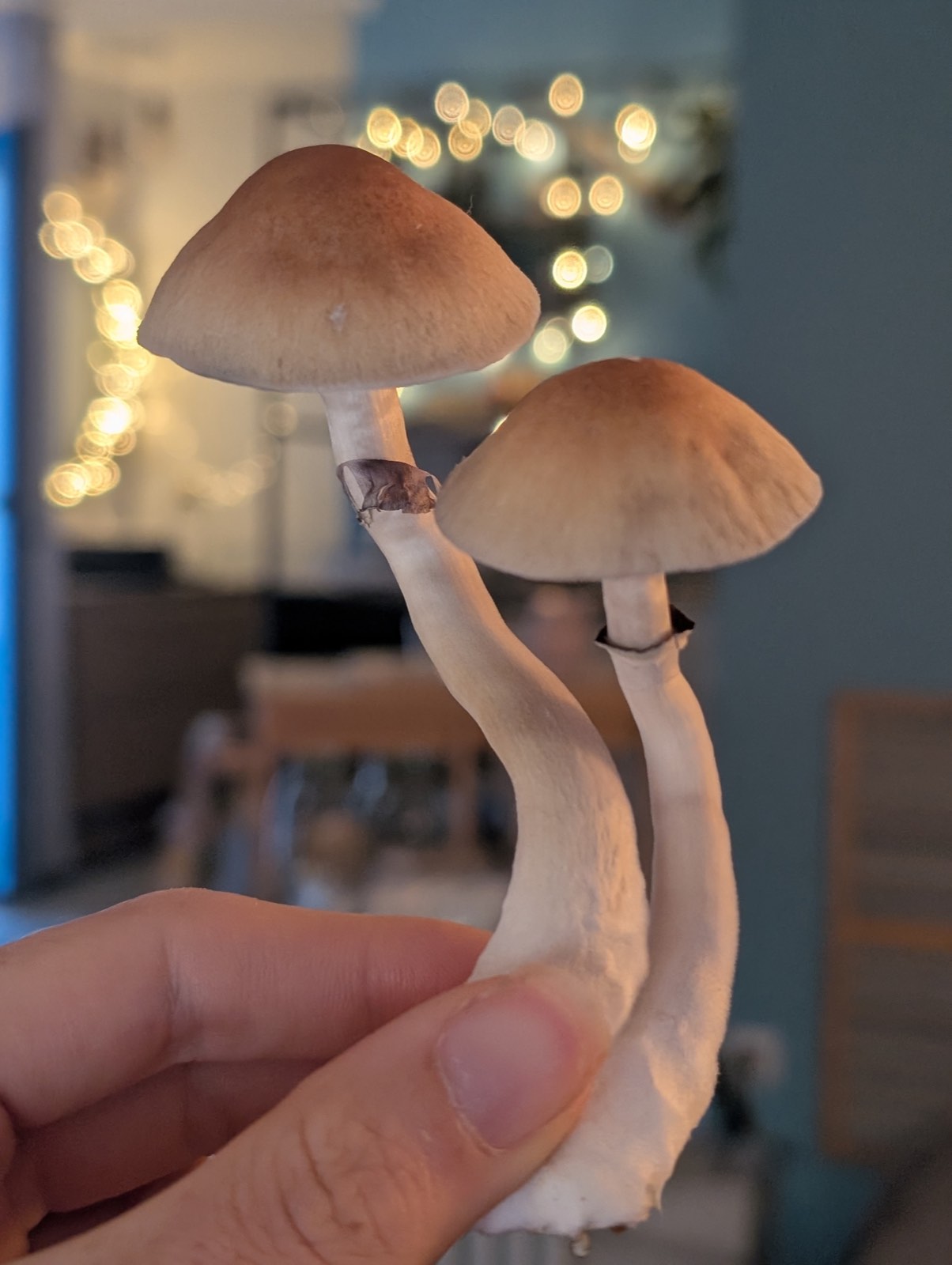
Mushrooms crept into our life sideways. It started with a single oyster mushroom grow kit, a slightly gimmicky-looking box we bought half as a joke, and within two weeks we had a shed full of grow bags and a much more serious interest in fungi than either of us expected.
Learning to grow
Oyster mushrooms are the forgiving entry point most growers start with, and for good reason — they'll fruit off almost any lignin-rich substrate you give them and they're hard to kill outright, which matters a lot when you're learning. We moved from kits to bulk substrate fairly quickly: pasteurized straw, spent coffee grounds from a café down the road, and eventually hardwood logs inoculated with plug spawn for shiitake, tucked into a shaded corner of the garden to fruit over the following year.
What we didn't expect was how much patience the whole process demands. Mycelium colonizes a log slowly, invisibly, for months before you see anything at all. It's the opposite of the instant-gratification hobby the grow-kit marketing implies. We now think of the mushroom shed the way we think of the sourdough starter — something quietly working in the background that occasionally needs our attention and mostly just needs to be left alone.
You don't grow mushrooms so much as you build the mycelium a good enough home and get out of its way.
Beyond the kitchen: the Stamets stack
Growing food-grade mushrooms led us, the way these things do, down a research rabbit hole into functional mushrooms more broadly — reishi, lion's mane, and eventually into reading about mycologist Paul Stamets' well-known "stack" protocol, which pairs microdoses of psilocybin mushrooms with lion's mane and niacin, based on his own hypothesis about supporting neurogenesis.
We want to be honest here rather than either dramatic or dismissive about it: we read a genuinely wide range of material before forming any opinion, including the primary interviews where Stamets describes his personal protocol, and the more skeptical scientific commentary pointing out that the stack itself hasn't been through rigorous clinical trials — the evidence for any of its three components, combined in that specific way, producing the claimed cognitive benefits is mostly anecdotal at this point. That gap between "compelling personal account" and "established science" seems important to sit with rather than skip past.
What we can speak to honestly is our own, entirely subjective experience — noticing effects on focus and mood during periods we tried a version of the stack, alongside all the usual caveats about placebo, expectation, and the fact that neither of us is a controlled study of one. We're growing lion's mane ourselves now regardless, because it's a genuinely good cooking mushroom on its own merits — texture like crab, mild, forgiving to cook — independent of any of the microdosing conversation.
Where we've landed
Mostly, mushrooms have become one more thread in the same rope as the garden and the kitchen: something slow, a little mysterious even after you've read everything you can find, and better understood by doing it for a season than by any amount of research beforehand.